
“We have mistaken excess for success and scarcity for discipline. I reject this… wretched lie. If wealth must exist, then let it serve life and not rule it, for there shall be no kings of coin beneath my crown.”
-Emperor Vierros Alzari to his court.
| GENERAL Name: Vierros Alzari Race: Varkrys Born: 240 AE, Crimson Sanctuary, Thospeiros Dynasty: The Illustrious Alzari of Vaherdal House: Alzari of Thospeiros Imperial Alzari Coronation: 261 AE, God’s Chosen, Aschatava Predecessor: Emperor Icairros Alzari Heir: Imperial Princess Avaras Alzari Patron Deity: Vaherdal |
| TITLES Lord of Crimson Sanctuary Prince of Thospeiros New Moon of the Empire The Empire’s Full Moon Emperor of the Empire of Ederav He who was chosen by the Gods ALIASES The Gentle The Fair The Gods’ Wisdom Beloved Ruler of All |
| FAMILY Father: Imperial Prince Hexairros Alzari Mother: Lady Nytharas Aldehar Sibling: King Jaerros Alzari Spouses: Empress Consort Cianantiras Alzefeni The Pretender Empress Lover: Lady Sadoras Altehuri (rumored) Issue: Imperial Princess Avaras Alzari (from Cianantiras) Imperial Prince Aethrros Alzari (from The Pretender Empress) |
Emperor Vierros Alzari, also referred to as Vierros the Gentle, is the fifth and current ruler of The Empire. Following his father’s death in 232 AE, he developed a deep commitment to balance and equity within the empire, reasoning that his father’s fate might have been avoided in a society where resistance to positive change and cynicism were unknown.
Vierros ascended to the throne at twenty-one, following the abdication of his grandfather, Emperor Icairros Alzari. He was crowned in 261 AE in God’s Chosen, Aschatava. Seven years after his coronation, he enacted the Equilibrium Utopia law. This unprecedented move set the stage for sustained conflicts with his consort, Cianantiras Alzefeni, which would ultimately culminate in her death.
In Eihanfi, his full name and titles would be Thalasan Vierros Alzari va Thospeiros othun Thalasanathur va Ederav.
Appearance
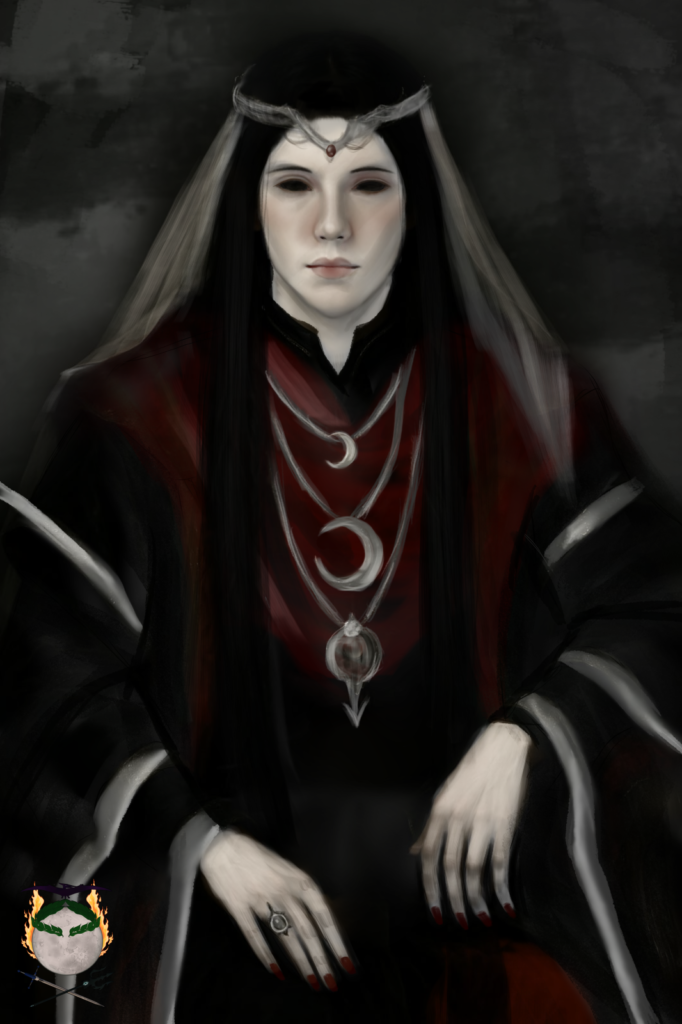
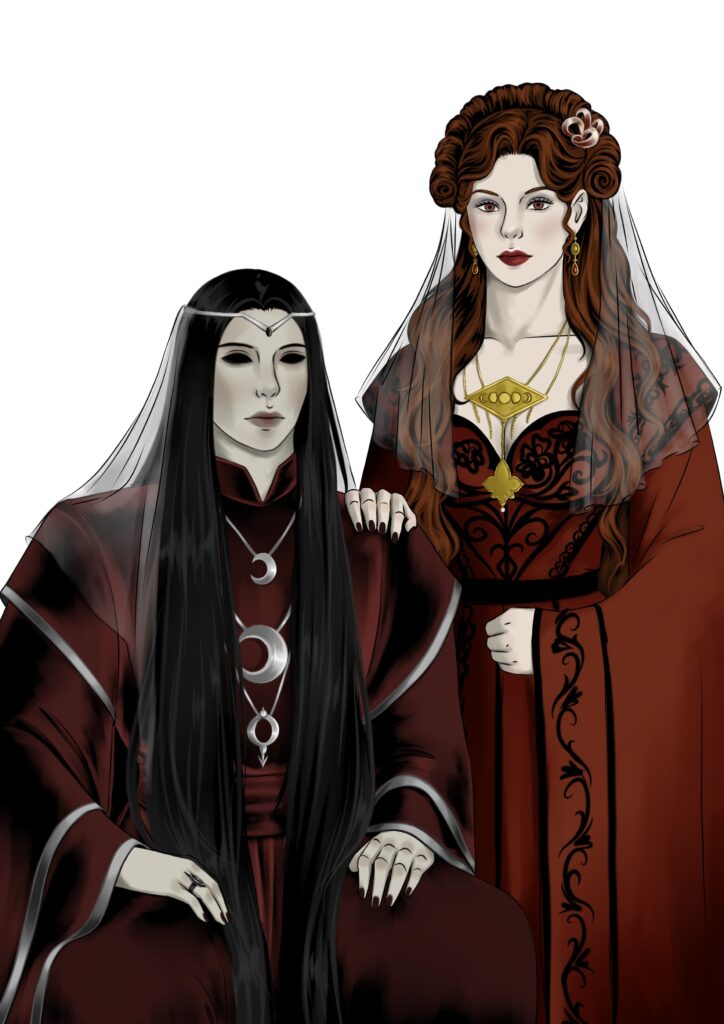
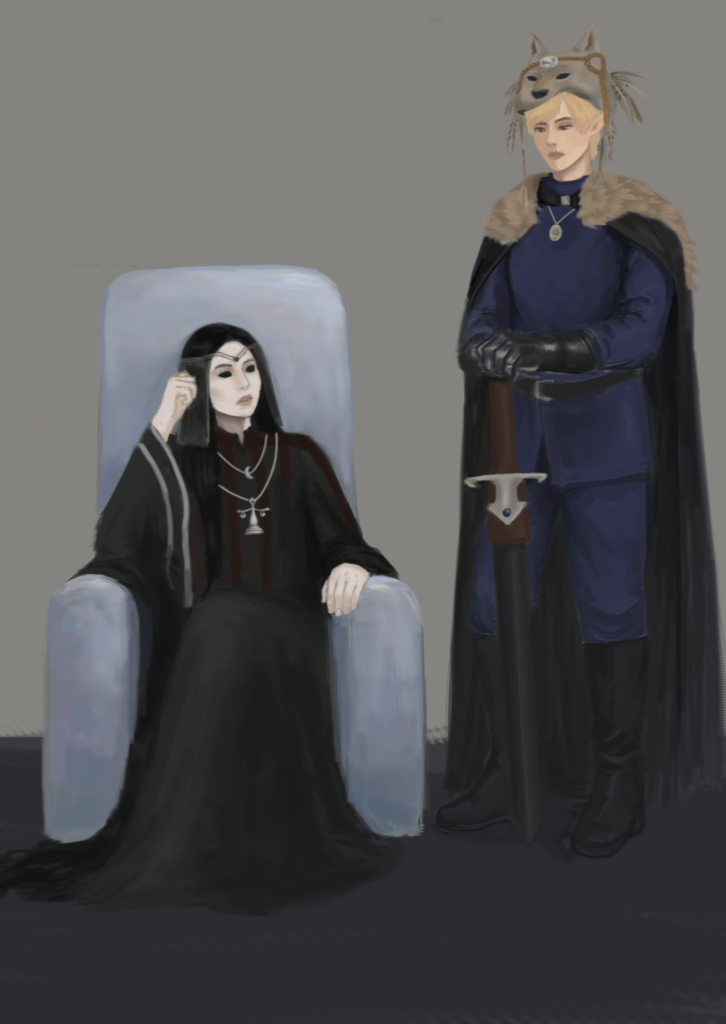
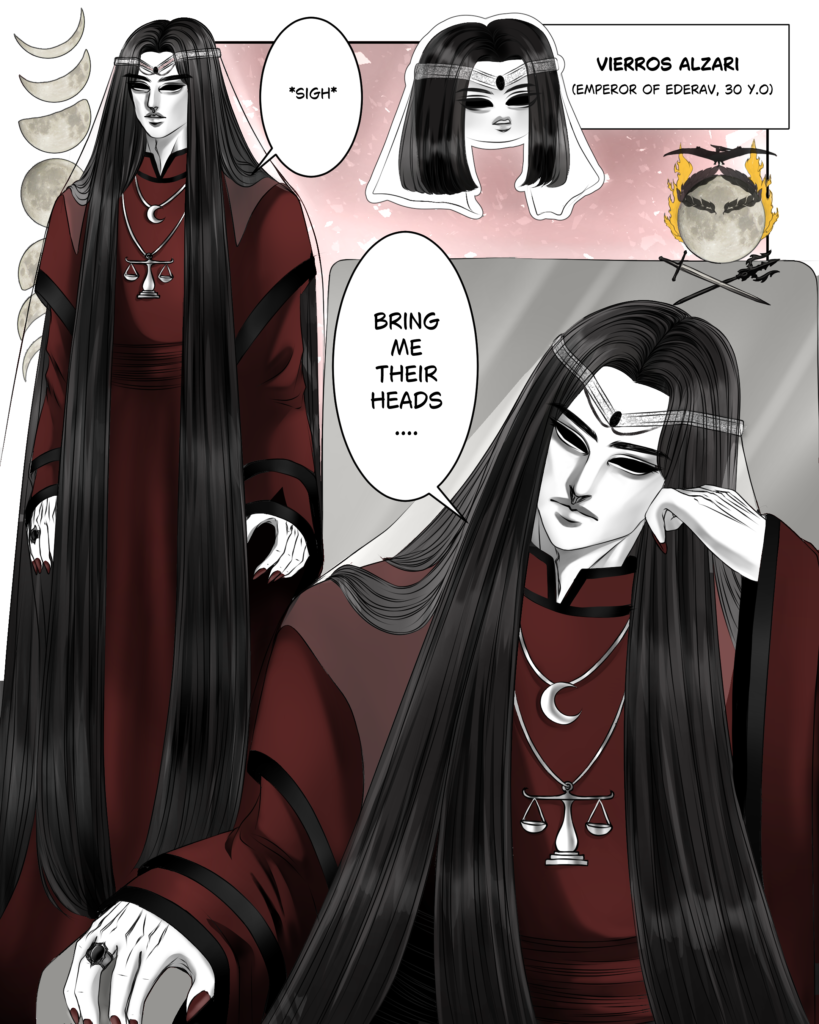
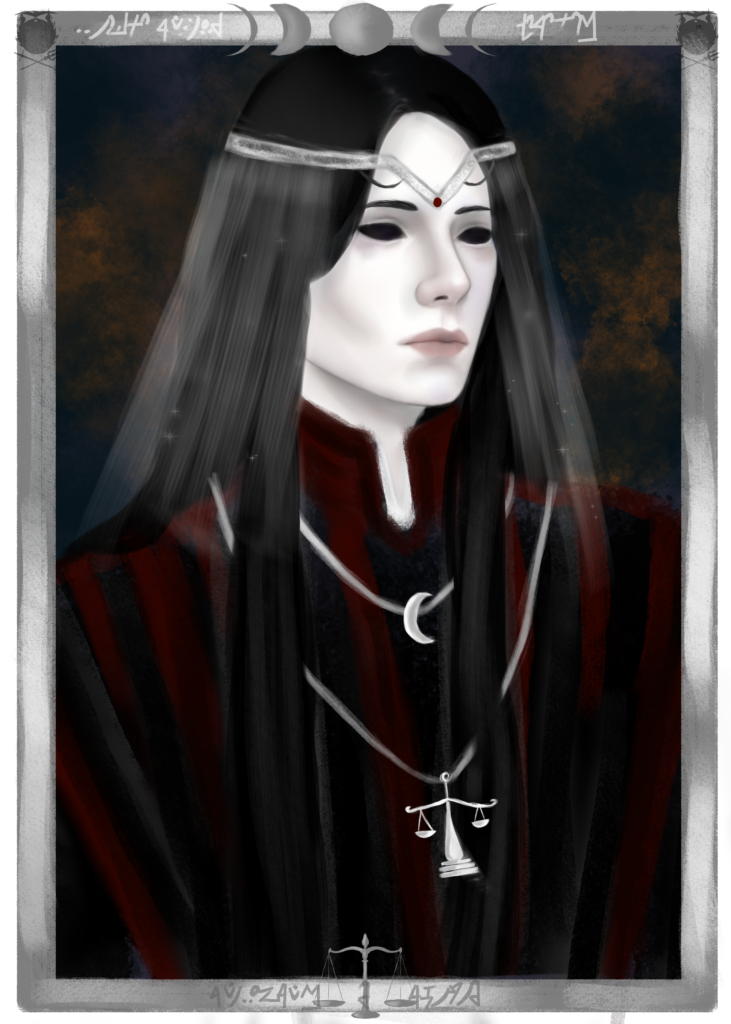
Vierros possesses bone-colored skin, void black eyes, and exceptionally long hair, which he maintains in accordance with the more traditional views of Varkrysathur culture. His hair reaches two and a half meters in length. Vierros is tall and slender, often slouching due to years of desk work. Healers have remarked upon his ‘soft body and even softer skin.’ His fingertips are permanently stained with black ink from extensive writing.
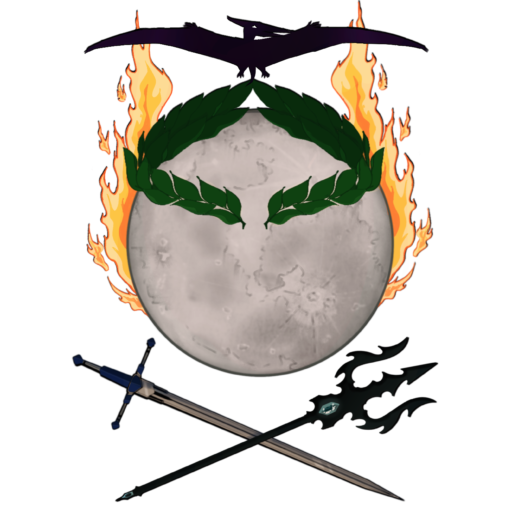
Vierros prefers to dress in traditional Varkrys attire in black and red, embellished with silver. Though often depicted with the Empire’s moonstone crown, he is seen with other crowns or his hair braided. Since marrying Cianantiras Alzefeni, he has occasionally worn a veil.
Bards and poets who have observed the Emperor often describe Vierros as possessing a more maidenly than masculine appearance. Consequently, theatrical portrayals of him are frequently performed by female actors.
Personality and Character
Vierros is reserved and introverted. He speaks infrequently in a soft, whisper-like tone that forces others to listen attentively. Like all Varkrys, his footsteps are nearly silent, and he often stands unnoticed behind his councillors until they become aware of his presence. He listens more than he speaks and avoids overburdening his court, instead quietly assuming portions of their work and completing them late at night, to the displeasure of the pretender empress.
Cianantiras’ constant belittlement and criticism of his appearance led Vierros to despise mirrors, and he had all mirrors in his personal chambers removed. From a little after Avaras was born to Cianantiras’ death, Vierros would wear a veil over his face, and only remove it after the pretender replaced Cianantiras. Even so, the damage has been done; Vierros would only allow his healers to examine him in the dark and refuse to meet people’s eyes when they stare at him for too long.
Despite his demanding responsibilities, Vierros is a devoted father to Avaras and Aethrros, making efforts to spend time with his children and regularly joining them for supper.
Vierros is deeply committed to establishing a utopia in which poverty is eradicated, healthcare is accessible, and even the most humble citizens have adequate living conditions. He visits orphanages to teach literacy, inspects academies, attends to the sick in sanatoriums, and consults with farmers and craftsmen to gather their perspectives. Compared to his forebears, he is exemplary. However, his dedication to the greater good would lead him to take drastic measures, occasionally at the expense of himself and those around him. Although Vierros does not relish brutality or death, he recognizes the necessity of eliminating opposition and delegates such tasks to Valacar Draven Vakveldir or Prince Rakai Ardeyi.
History
Early life
Vierros was born in 240 AE at Crimson Sanctuary, Thospeiros, to Imperial Prince Hexairros Alzari and Lady Nytharas Aldehar of Last Crypt. He retains few memories of his mother, who had always been ill after his birth and died a moon cycle after the birth of his younger brother, Jaerros. Many of Vierros’s recollections of childhood are indistinct; often, he cannot recall his whereabouts during certain years or whether he enjoyed particular activities. When seeking clarity about these early years, he relies on Jaerros to help reconstruct his memories.
Vierros spent most of his early years, from birth until age eight, in Crimson Sanctuary, while the ongoing opposition to Hecarros Alzari’s purge and Icairros’ rule re-emerged. He recalls his father’s frequent absences, as Hexairros was often away fighting insurgents. During the Great Raid of Aschatava, the outlaws, led by the deposed Lord Iacherros Alathura, were defeated, but Hexairros was killed in the process, and his remains were returned to Crimson Sanctuary in an armory chest. Vierros managed to glimpse the remains when Natheressir Ironwood opened the chest and later remarked to the pretender empress that it reminded him of a minced pie.
Following his father’s burial, Vierros secluded himself in the tower library of Crimson Sanctuary for two years, dedicating the entire period to studying law and developing the early concept of Equilibrium Utopia, which, at the time, he called ‘the vision’. Despite persistent objections from Natheressir and Jaerros, as well as a visit from Icairros, he remained resolute in his self-imposed isolation. To accommodate his prolonged stay, he arranged for a bed to be moved to the tower’s summit and had his meals delivered daily.
In 251 AE, after two years in the tower, Vierros relocated to the Isles of Helmeras to pursue further legal and scholarly studies, choosing not to join the Order. The council of Crimson Sanctuary reportedly attempted to prevent his departure, insisting that his responsibilities lay in learning governance at Crimson Sanctuary. In response, Vierros suggested that his grandmother occupy the Crimson Throne with Jaerros on her lap, as it would eventually become his seat. Recognizing Vierros’s determination, Icairros granted him permission to leave.
Marriage to Cianantiras Alzefeni
As Icairros prepared to abdicate the imperial throne in the late 250 AE, discussions arose regarding Vierros’s succession. Believing that an emperor should not rule without a consort, Icairros arranged a marriage between Vierros and Lady Cianantiras of House Alzefeni, daughter of his confidante and council member, Lord Artherros Alzefeni. The two married in the spring of 255 AE.
Initially, Vierros was attracted to Cianantiras despite his own shyness and reserve – Cianantiras, being older and more adept at courtly intrigue and seduction, possessed undeniable charm and quick wit that bewitched Vierros. Four years after their marriage, in the fall of 259 AE, Cianantiras gave birth to Avaras. However, after the princess’s birth, their differences soon became pronounced; in contrast to her stern and frugal father, Cianantiras was a woman of indulgence, greed, and arrogance. She held herself back until after Avaras was born, thinking that Vierros would yield to her wishes and command after she gave him an heir. Vierros, however, remained devoted to his vision of balance and humility, leading to frequent conflicts with Cianantiras.
Cianantiras had little empathy for the commoners, openly disparaging Vierros’s initiatives to support orphans and peasants, whom she dismissed as ‘fodders’. She resented the attention he devoted to the lower classes and believed that imperial resources should be reserved for the nobility. Her extravagance was evident in her frequent diversion of palace funds – which were intended for maintenance and servants’ wages – to purchase luxurious dresses and jewels.
Vierros, ever steadfast in his ideals, imposed restrictions on Cianantiras’s spending, which further strained their relationship. In response, Cianantiras withheld intimacy and grew embittered, her verbal attacks intensifying with each dispute. Her abuse extended beyond Vierros to their daughter, Avaras. To prevent Avaras from being constantly exposed to Cianantiras’ cruelty, Vierros took her and left her with Thospeiros under the guise of imperial progress.
During his stay at Crimson Sanctuary, Vierros became acquainted with Lady Sadoras Altehuri. After a fortnight, he returned to Aschatava, entrusting Avaras to her uncle’s care and inviting Sadoras to accompany him. Initially, Cianantiras paid little mind to Sadoras’s presence – until Vierros painted her portrait and gifted it to Sadoras herself. Offended and suspicious, Cianantiras promptly dismissed Lady Sadoras from the court and raped Vierros. It resulted in another pregnancy, though Cianantiras eventually miscarried and had to have her womb removed due to injury-related necrosis post miscarriage. This medical information was not disclosed to the public.
Afterwards, Vierros and Cianantiras’s disputes became more frequent and visible, with heated arguments resonating throughout the palace halls. Tensions escalated further following the introduction and signing of the Equilibrium Utopia decree at the imperial summit of 268 AE. After the decree was signed by other kingdom leaders, Cianantiras threatened Vierros by claiming that if he continued to ‘choose fodder over her’, she would seek another man, or, more disturbingly, sell the young princess Avaras to a wealthy merchant. In a rare moment of fury, Vierros pushed Cianantiras down a staircase. She struck her head and succumbed to her injuries immediately.
The commotion alarmed Clan Mother Lembayung and General Kael Vakveldir, who were nearby. They arrived promptly and grasped the situation. Disturbed by the incident, Vierros confessed to killing Cianantiras and intended to surrender to the Order of Helmeras for trial. Kael and Lembayung intervened, emphasizing that Avaras, his heir, was only nine years old, and that Jaerros, not yet married and the King of Thospeiros, would have to ascend and leave his throne vacant.
Kael insisted that the incident must be covered up, suggesting that the empress be declared gravely ill and quietly replaced. Kael mobilized 170 loyal warriors and trackers to search for a replacement while Lembayung dealt with Cianantiras’ body. Vierros confided in Jaerros, who agreed that this was the safest course; even if Cianantiras’s death was ruled accidental, Vierros would still be compelled to remarry, which could threaten Avaras’s position if his new wife bears him a child. Therefore, Jaerros spread the word and arranged matters so that it seemed Cianantiras was ill and had departed for Thospeiros to recover her health.
Trivia and Miscellanelous
Trivia
- Vierros’s favorite dish is deep-fried scorpions.
- Vierros hates mathematics, but forced himself to learn enough to understand financial reports.
- Despite Varkrysathur culture of men wearring an earring on one of their ears, Vierros never head his ear pierced and does not adhere to this specific custom.
- Vierros loves na’ita and would let a na’ita play with his hair.
- The only time Vierros ever been to a brothel was when he chaperoned Kael and Arezei. He threw up at the sight and refused to visit a brothel ever again, saying that it was ‘an obscenity I am uncertain as to why the gods let it be’.
- He calls the pretender empress ‘Ananti’.
- Prior to the Equilibrium Utopia, Vierros had planned to wed Avaras to his brother, Jaerros.
- Vierros deeply idolizes his ancestor, Hecarros the Plague, and agrees with all his ideals, though he would never say it out loud.
- Vierros once sent an erotic poem to the pretender empress, but Nagor ended up reading it and he refused to leave his chambers for six days out of embarrassment.
Quotes by Vierros Alzari
- “Mount your beast, my prince. Take to the skies and bring me the heads of those who oppose me – for their resistance greatly saddens me, and perhaps you would do so to alleviate my grief.”
-Vierros to Rakai Ardeyi - Vierros: “I serve this empire and my people first and foremost – nobles or lowborns.”
Cianantiras: “Choose the fodder, my emperor, and you will find me abed with a man wealthier and more virile than you could ever be.”
Vierros: “Then I would crown a whore as my consort. What differences would it make from crowning you?”
-Vierros and Cianantiras Alzefeni - “You have the face of a woman I loathed and the heart of a woman I dreamt of.”
-Vierros to the pretender empress - Vierros: “Perhaps the fault was within me, princess, to entrust you so blindly to that man.”
Avaras: “Your fault was that you replaced my dead mother… and my fault was that I never suspected for a second.”
Vierros: “Was Cianantiras Alzefeni ever a mother to you? Was she ever a wife to me, or a family to us? If you believe that she ever was, even for a second… then I fear we are both blinded in our own ways.”
-Vierros and Avaras Alzari - “You have seen me bludgeoning a man to his death, my prince. I fear I would have to do it again if you hurt my daughter.”
-Vierros to Nagor Ardeyi
Behind the Scenes
Vierros was one of the first characters I created in Ederav universe. He was intended to be young and easily-manipulated by Cianantiras. In my original draft, Cianantiras and Aegyr were the antagonists of the story, and he had to murder Cianantiras to stop her – which led him to his own suicide while having no heirs and the imperial throne to be vacant. Eventually, Kael (Then Nikolai) took the throne.
In my original draft, Nagor was actually his half-brother and Avaras never existed. He also looked starkly different than he does now, as in the original draft, he had short brown hair and red eyes.