Varkrys
The lawmakers, the firstborn, the children of Vaherdal
“We do not rise above others by will… only by origin.”
—King Zaerros Alzari, the first Alzari patriarch
The Varkrys are one of the six sentient races of Ederav and are widely regarded as the most ancient among them. They were created by Vaherdal, the God of the Moon and Endless Night.
Closely associated with principles of balance, order, and codified law, the Varkrys played a foundational role in the early development of Ederavasathur society, governance, and imperial ideology. Their legal and administrative frameworks became the basis of civilization across Ederav, with most extant laws and regulations either derived from, inspired by, or directly instituted through Varkrys jurisprudence.
Although relations with other races have often been characterized by tension and reluctant deference, the Varkrys function as the primary civilizational reference point by which legitimacy and order are measured. In the present time, they retain political supremacy as the ruling race of the Empire, maintaining decisive influence over all its institutions and legal structures.
Origins
There is no exact recorded time of when the Varkrys were created by Vaherdal, but the Holy Scripture – along with scholars and historians – stated that during the first era (also known as the Age of Abyss), Vaherdal took chunks of rocks and shaped it to two creatures he named Orros and Arras; the first Varkrys. The Varkrys were created long before the sun, the trees, and the oceans came to existence; they were designed by Vaherdal to endure the eternal night. Their creation is often described not as a blessing, but as an assignment. The Moon God did not grant them warmth or abundance. Instead, he granted them clarity, patience, and longevity. Scholars believed that the Varkrys were created by Vaherdal around 90,000 years to 100,000 years ago.
When the sun goddess Elonie later brought daylight into the world, cave paintings and ancient carvings recounted that many of the earliest Varkrys were unable to withstand expose to sunlight, forcing them to flee underground. This event is interpreted not as weakness, but as proof that the world itself changed after their creation, making them the most ancient civilization to ever exist in Ederav. They stood, until today, leading the Empire and everything within.
From the beginning, the Varkrys were meant to last. This divine origin is central to Varkrys identity. They do not see themselves as ‘chosen’ in a triumphant sense, but they see themselves as bound to the role; to be a Varkrys is to carry an obligation toward stability, order, and continuity-even when such values conflict with compassion or desire.
The Varkrys named themselves Varkrys from the word ‘Va‘ (meaning ‘of’ in Eihanfi), and ‘Rakhris‘ (eldest), meaning that they are of the eldest race and the eldest God, Vaherdal.
Physical Characteristics
Originally, the Varkrys retained the appearance of Vaherdal; black of hair straight as a pin, white of skin, tall, almost gaunt stature and eyes like two pools of void. After nearly four thousand years of interbreeding with the Traxei, their appearance shifted; Present era Varkrys still have that bone-white skin, but their hair range from pitch black to dark brown to auburn, and their eyes range from black, to brown, to red, and to yellow. Only the members of House Alzari retain the original Varkrys appearance.
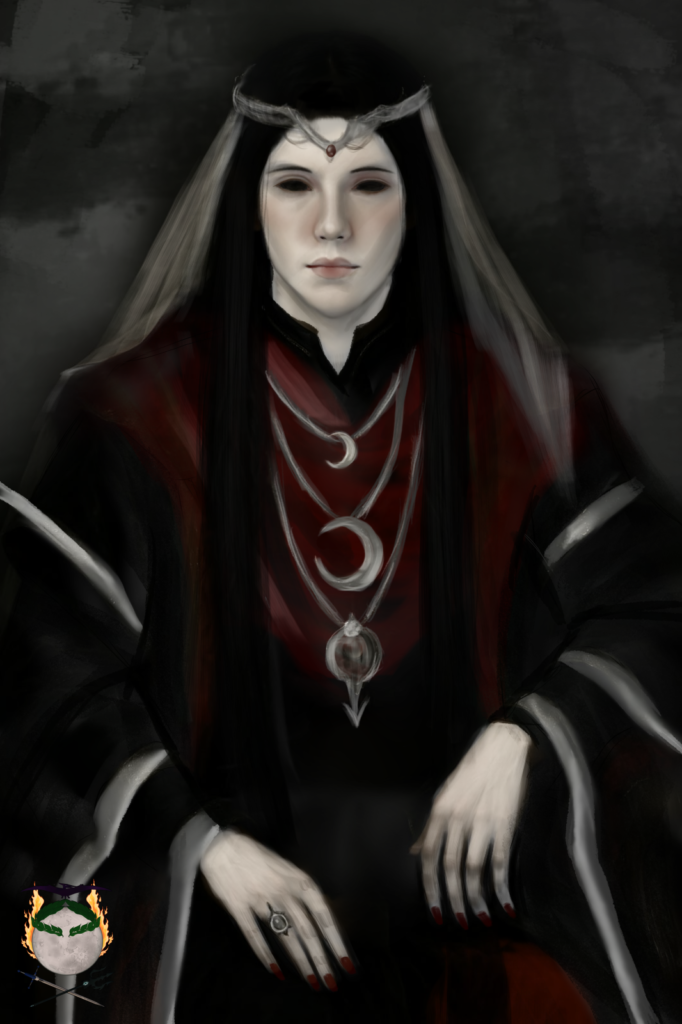
As the Varkrys were created before Elonie created the sun, they could not withstand the sun and their skin would burn and blister from the light, causing them to flee to the caves to stay alive and eventually established the gargantuan underground Kingdom of Thospeiros. Nowadays, the Varkrys can withstand the sun for a period of time before they get rashes or blisters. The other races, such as Ulfhar and Sethri, see them as ‘unnerving to look at’, while most Traxei see the Varkrys as the pinnacle of beauty and often exoticize them – to the point that a brothel without a Varkrys courtesan in Phyrozes cannot socially be considered as a brothel at all.
The Varkrys prefer to dress in darker colors to blend with their surroundings. Materials such as spider silk and moss linen are often used by the Varkrys, and the Varkrys are known to wear long, flowy robes to protect their skin from the sun. Male Varkrys tend to not wear gold as gold is seen as the jewels of Mayathi and not Vaherdal’s. In turn, Varkrys ladies would only wear gold. The Varkrys’ symbols are moons, stars, and bugs.
Regardless of their eye color, all Varkrys can see perfectly in the dark and are able to let out an inaudible noise to echolocate their surroundings, making them the perfect inhabitant of Thospeiros. The Varkrys are mostly insectivores and they consume moss, lichens, mushrooms, and cave tetras as well.
Stereotype and Personality
The Varkrys are reserved to the point of austerity; speaking sparingly and with deliberate care. Conversation with a Varkrys can feel unnerving to those accustomed to immediacy as the Varkrys enjoy lingering pauses, stretched silence, and words are chosen as though each carries consequence. Where other cultures rely on expression and volume, the Varkrys allow restraint to speak for them. Silence, in their society, is not absence-it is respect.
The Varkrys are widely regarded as law-bound (even obssesed) with structures and regulation. Written statutes, ancient precedents, and unwritten codes of conduct shape nearly every aspects of their lives. To other cultures, this devotion can seem suffocating or inflexible, but within Varkrys culture, law is not a cage and rather a scaffold; order is imposed not for control, but to prevent collapse, excess, and moral drift. A world without structure, in the mind of the Varkrys, is a world already halfway to ruin.
Pride is another trait frequently ascribed to them, often with accusation rather than admiration. Other races may think that the Varkrys are arrogant, aloof, or dismissive-and the Traxei would often believe that they are simply playing ‘hard to get’ – yet this perceived side is inseparable from their identity. The Varkrys carry histories that span for millenia; memories layered upon history, victories and failures alike etched deeply into their ever-evolving laws. What others mistake for arrogance is simply just the Varkrys being a race who remember and scribed too much to be easily impressed with anything new.
The Varkrys are remembered as the first-born (as they are the first race, and even possibly the first creature, that ever exist in Ederav), the foundation of law and the empire. Their flaws are many; detachment, rigidity, domination… to name a few. But no other race denies that without the Varkrys, Ederav would have no spine, no laws, and no throne. Even so, other races still see the Varkrys as cold and distant. However, the Varkrys reject this characterization, instead describing their temperament as ‘contained, not withheld’. To the Sethri, making a Varkrys lose their composure is almost akin to a sport.
Culture and Social Structure
Varkrys society is rigidly hierarchical, with status determined primarily by ancestry. Firstborns, regardless of gender, are to inherit most (if not all) of their predecessors’ legacy, while children born afterwards would usually be married off to firstborns or serve in their older siblings’ court and beyond.
Nobilities and noble houses are the cultural, social, and political backbone of the Varkrys. Noble houses trace their ancestry to early moon-born bloodlines, with House Alzari claimed to be the descendant of Vaherdal himself. The noble houses of Thospeiros would have their names begin with Al- prefix (derived from Vaherdal). Lineage records are treated as near-sacred documents, and falsification is amongst the gravest social crimes.
There are currently eight noble houses governing the eight cities of the Kingdom of Thospeiros. Namely:
- House Alzari of Thospeiros, established by King Zaerros in 4,203 BE. The ruling house of Thospeiros with Crimson Sanctuary as its seat. The lawmakers and the most ancient recorded noble house in Ederav.
- House Aleran of Fang’s Hold, established by Aelirros and Rakairros Alzari in 3,681 BE. The ruling house of Fang’s Hold and is infamously known to be the deadliest, most brutal house in the whole of Thospeiros… and possibly all of Ederav.
- House Alzefeni of Blood Moon, established by Brelaras Aleran in 3,601 BE. The ruling house of Blood Moon and is specialized in trading. Their city holds the Eclipse Port, the biggest port in Thospeiros.
- House Altehuri of Eternal Mist, established by Nyseras Aleran in 3,524 BE. The ruling house of Eternal Mist and the kin house of House Arethuzi of Sky Fort. Known for its agriculture.
- House Alhadyr of Sky Tear, established by Thyras Alzari in 2,978 BE. The ruling house of Sky Tear and the masters of architecture and smithery. Masters of the Bleeding Forge, the biggest forge in Thospeiros.
- House Aldehar of Last Crypt, established by Vaerros Alzari in 2,901 BE. The ruling house of Last Crypt and the historians of Thospeiros. The first cave painting can be found in a cave-turned-vault in this city.
- House Aluneides of Night Call, established by Alunaras Aleran in 1,701 BE. The ruling house of Night Call. Specialized in potion crafting, alchemy, and toxins.
- House Alvaher of Void’s Rest, established by Nedeirros Altehuri in 1,638 BE. The ruling house of Void’s Rest and the cultural compass of Ederav. Whatever they adopt, create, or endorse inevitably becomes the standard others follow.
Originally, there were over hundreds of noble houses in Thospeiros, emerging and descending as time passed. However, after the Great Industrial Purge, only eight houses remain.
All Varkrys would have -ros and -ras suffix in their name to honor their ancestor, Orros and Arras. Noble-born male Varkrys would have double r in their name to highlight their noble blood. Names are often repeated to honor their ancestors, except the name Orros, Arras, and Ahferas, the lady of Fire. Variations of those names may be used to name a Varkrys child, so long as they are not spelled the same way.
Marriage among the Varkrys is typically strategic, arranged to strengthen bloodlines or political alliances. Romantic attachment is considered secondary to duty, though not forbidden and is rather encouraged. Children are raised communally within houses, with education emphasizing discipline, historical literacy, and obedience to hierarchy.
Firstborns usually have their marriages arranged, while their younger siblings would have more freedom in choosing their partners. The Varkrys have the most dominant genetic out of all races, so typically they would not be worried about diluting their blood through intermingling with other races. After the Empire formed, many Varkrys noble are notorious for keeping Aqsha exiles as bed partners.
The Varkrys are strictly monogamous but are not always tied to marriages; back in their colonial days, children born from Traxei slaves were to inherit their Varkrys parents’ house and inheritance, even when there were no marriages between the owners and the slaves.
Relations with Other Races
Varkrys’ perspectives toward other races are not shaped by hostility and rather by a deeply ingrained sense of historical responsibility, aesthetic judgement, and assumed custodianship. While they continue to view themselves as the anchoring force within Ederav, their relationship with other races are neither uniformly dismissive nor purely hierarchical. Even so, they do believe that they are the ‘caretakers’ of other races.
How Varkrys see the Traxei
Generally, Varkrys’ attitudes toward the Traxei are marked by complex mixture of regret, familiarity, and reluctant (but much desired) intimacy. The history of Varkrys colonization of Traxei shaped both races to a genetic level and there exists a genuine sense of responsibility and kinship over the Traxei among Varkrys elites.
At the same time, many Varkrys perceive the Traxei as culturally adjacent rather than truly foreign. Centuries of entanglement have produced a sense of kinship that is difficult to disentangle from domination. This closeness manifests in paternalistic attitudes, shared political frameworks, constant arranged marriages between Varkrys noble houses and Traxei noble houses, and an unspoken assumption that Varkrys governance (however flawed) remains preferable to Traxei autonomy.
How Varkrys see the Venefian
The Venefian are regarded by the Varkrys as their closest equals. Unlike other races, the Venefian are not framed as dependents, but as intellectual and spiritual counterparts. If the Varkrys are the lawmakers, the Venefian are the religious cross-checkers. To the Varkrys, law and religion should go hand in hand.
Varkrys scholars have long admired Venefian literature, philosophy, and historical record-keeping. Venefian texts are commonly preserved within Varkrys archives alongside their own canonical works and vice versa. However, this respect is often tempered by skepticism; the Varkrys would frequently describe Venefian’s religious devotion as excessive, even destabilizing. Their proximity to divinity, while admired, is also perceived as a liability that could tip into fanaticism. As such, Venefian influence is welcomed in discourse, religious worships, and art, but approached cautiously in matters of governance and lawmaking.
How Varkrys see the Ulfhar
The Varkrys’ views of the Ulfhar are shaped by a combination of admiration and distance. The Ulfhar are widely acknowledged as honorable, resilient, and deeply bound to their land. Varkrys military treatises and dockets often cite Ulfhar warriors as exemplary in discipline and endurance, particularly in hostile environments. Their social codes are seen as internally consistent and worthy of respect (despite Varkrys would have their eyebrows raised at Ulfhar’s polygamous nature).
Nevertheless, the Ulfhar are also regarded as culturally insular; their focus on warfare and refusal to adopt Varkrys administrative system (despite half of Ulfhar’s laws are based on Varkrys’ laws already) are often interpreted as evidence of ideological stagnation. To the Varkrys, the Ulfhar represent a noble warrior path that chose depth over expansion; a choice respected, but ultimately viewed as ‘limiting’ and even ‘too tribalistic’.
How Varkrys see the Sethri
The Sethri evoke a mixture of apprehension and fascination among the Varkrys. Their association with chaos, fire, and volatility places them outside the Varkrys’ preference for controlled continuity. Sethri political structures are considered unpredictable, and their emotional expressiveness is often cited as a destabilizing factor in diplomacy.
Despite this, many Varkrys are notably captivated by Sethri’s physiology, particularly their wings. These are studied not merely as anatomical curiosities, but as symbols of power unbound by restraint. Sethri wings are frequently referenced in Varkrys art and allegory, representing both awe and danger. Sethri courtesans are, more often than not, a popular choice to single Varkrys frequenters.
How Varkrys see the Aqsha
The Aqsha are widely regarded by the Varkrys as fundamentally alien. Their aquatic nature, fluid social structures, and non-terrestrial modes of perception place them beyond conventional Varkrys framework of understanding. This unfamiliarity often gives rise not to fear, but to curiosity.
Among many Varkrys, the Aqsha are spoken in aesthetic terms; beautiful, elusive, and desirable. This fascination is not purely academic and it carries and undercurrent of possession. The idea of ‘bringing an Aqsha home’ appears frequently in Varkrys’ literature and private correspondence, framed less as conquest and more as acquisition. Such attitudes reveal more about Varkrys’ psychology than Aqsha’s reality: that to the Varkrys, unfamiliar things are often translated to collectibles, controllable, and ultimately domestic.
History
The early civilization
The holy scripture of Ath-Einhaf mentioned that Vaherdal created the Varkrys long before Ederav was a land habitable for living, and even before Ehanfi sprouted. It was said that the Goddess Elonie was at first angered at the existence of the first Varkrys Orros and Arras, as Vaherdal would spent time with his little creations than with her and Ehanfi (who was then still a seed). When Ehanfi stopped growing and Elonie was distraught, she created the sun to help Ehanfi to grow. Unbestknown to her, the sun she created burnt and scarred the Varkrys’ skin, and Vaherdal had to split the land to create caverns for the Varkrys to fled and live in.
Forced undergrown by the arrival of the sun, early Varkrys communities adapted to cavern systems, relying on fungal agriculture. When Helvarr came to existence and created animals, they relied on subterranean fauna and controlled nocturnal emergence for hunting. It is within this period that the first known cave paintings of Ederav appeared.
These early murals, found deep within Varkrys cave networks, depict not of hunting scenes or survival practices, but abstract lunar symbols, familiar groupings, and repeated geometric forms believed to represent continuity and lineage. Paintings depicting early forms of laws, structures, and socities summarized that the Varkrys were already pooling and sharing resources, traded with each other, and form marriages through alliance when other races were either not existed yet or were still in their prehistoric timeline.
When the Venefians were still trees using the sun and water as food sources, the Ulfhar were not yet bipedals, and the Aqsha were still closer to fish than they were to sentient beings, the Varkrys already at the turning point in their civilization; they had reached a level of stability sufficient to divert time, energy, and cognitive focus away from mere survival. The cave paintings, along with bone and stone jewelries found in their ancient sites, marked the moment they began to live and not simply endure.
In Varkrys historiography, this moment is often cited as the birth of culture itself.
The Kingdom of Thospeiros
The transition from scattered subterranean communities to organized statehood culminated in the founding of the kingdom under Thospeiros, from whom the city and later kingdom of Thospeiros takes its name.
Thospeiros is remembered less as a conqueror and more as a consolidator. His reign established the earliest codified laws, territorial claims, and hereditary rulership structures. Under his governanve, Varkrys society formalized its emphasis on lineage, record-keeping, and legal continuity. The Thospeirosian kingdom era marked the shift from communal survival to hierarchical civilization. Authority became centralized, governance ritualized, and history deliberately preserved rather than merely remembered. It was during this period that Varkrys legal philosophy emerged, emphasizing inevitability, precedent, and order over adaptability.
Several generations after Thospeiros, the Varkrys ruler Zaerros introduced the formal family naming system that would come to define Varkrys identity. Zaerros mandated the use of hereditary family names, standardized lineage records, and strict naming conventions tied to ancestry. This system served not merely as social organization, but as a method of governance. Identity itself became legible to the state. Zaerros named himself Zaerros of Alzari, taking the Al- from his beloved God Vaherdal and Zari from his own name. Soon enough, other Varkrys began to follow.
The Colonial period and Traxei subjugation
For generations upon generations, the Varkrys mined and lived in their subterranean kingdom. They became aware of the existence of other races, but for thousands (or more) years, barely had any significant contact with them.
This changed when King Barros Alzari, the great-grandson of Zaerros, received envoys from the volcanic regions bordering the entryway of their caverns; the Sethri. Their envoys brought to Thospeiros gold, copper, silver, brass… bent to jewels and armors. They arrived with their fire wings, enamoring each and every man and woman in Barros’ court. They dressed richly in bent metals and they brought with them their queen, Hevaeth of Zi’fen. Hevaeth promised Barros the knowledge on how to bend metal to their will with fire… in exchange of Thospeiros’ underground gems. Barros was sold; he proposed a marriage between them in exchange of her fire and and his mined goods.
This union, later termed the Smithery Alliance, marked a turning point in Ederavian history. Under its terms, the Varkrys supplied Zi’fen with high-quality ores extracted from the depths of Thospeiros, while the Sethri provided access to their volcanoc forges and its masters. The result was the creation of weapons vastly superior to those previously used across Ederav; bones and stone weapons.
With this prowess, Hevaeth proposed to Barros another project; lies within the central of Ederav is a fertile valley inhabited by the Traxei, then known simply as the valley and not yet Phyrozes. Hevaeth confessed that while the volcanic soil made Zi’fen grounds fertile, the windows of crop-farming is short as a lava eruption would destroy their yields. An agreement was reached betweent Thospeiros and Zi’fen that they would conquer the valley and the Sethri would claim the land itself, while the Varkrys would claim the people.
From the beginning, the Varkrys had always been smaller in number. Varkrys’ fertility rates, in general, were criticially low, threatening long-term population stability due to them descending from only two ancestors, Orros and Arras, thus had very shallow genetic pool compared to other races that were created in groups by other Gods. The Traxei, by contrast, were numerous and could be used for labour-internsive work. The Varkrys’ initial intent, as recorded in Thospeirosathur documents, was the use of the Traxei captives as miners, builders, and manual laborers.
With the combined forces of Varkrys’ brilliant strategy, Sethri’s strength and fiery wings, and their newly made metal weapon, the Traxei, their rugha and their valley collapsed in a year and a half. The Traxei and their rugha were hauled deep into the caverns of Thospeiros while the Sethri farmed their valleys and pillaged their resources.
It didn’t take long before the Varkrys had their mines and their marble building worked by the Traxei and their rugha, which were used to transport goods and lift heavy boulders. However, the character of Varkrys colonial practice changed decisively after fifty years, following the birth of four children to Queen Hevaeth and King Barros.
Despite Hevaeth’s pure Sethri origin, all four offspring were recognized as fully Varkrys, displaying stable inheritance of Varkrys traits and lack of Sethri’s fire wings on their backs. This even prompted a reevaluation of long-held assumptions of their low fertility; the Varkrys scholars and lawmakers concluded that interbreeding with other races offered a solution to their demographic stagnation. Their genetics, while shallow and hard to be progenerated within their own kind, happened to be the most dominant genetic in interracial relations. This was the time where they looked upon their Traxei slaves with another intent.
The moment the last of King Barros’ child, Princess Belaras Alzari, reached adulthood with no illness and disoder, the Traxei captives were reclassified not only as laborers, but as reproductive assets. Sexual enslavement was institutionalized and justified under the rhetoric of survival and continuity, Over time, this practice became normalized within Varkrys’ administration.
The Varkrys began taking what they consider to be ‘pleasing in visage’ Traxei as their sex slaves, with rights and privileges that allowed them to sleep with any Traxei they deemed worthy enough. Sex with attractive Traxei was considered casual recreations, and at some point, many of the Varkrys nobles competed to have cages and pens with the most desirable Traxei subjects. Children born from Traxei all resembled the Varkrys up to four generations of constant breeding with the Traxei, and thus, were legally considered to be the heirs of their Varkrys’ parents.
When Oberros’ laws of monogamy were legalized, the Varkrys would either take another Varkrys as a consort or a Traxei slave. At that time, the legal council of Thospeiros proposed a law to allow Varkrys to legally take Traxei slaves as their husbands and wives, but ironically, this law was declined by Lord Aelirros and Rakairros Aleran, both of whom were sired by a Traxei father. Thus, no more laws of the Traxei being potentially considered equal through marriage with Varkrys were ever proposed throughout their colonization.
Over the course of approximately 3,821 years, systemic interbreeding-often accompanied by selective breeding practices to prevent their genetic pool to completely changed-altered the physical characteristics of the broader Varkrys population.
While House Alzari and a small number of ancient noble bloodlines retained their pure ancestral features, the average Varkrys appearance gradually shifted; their bone structure softened from Traxei’s genetics, their height and coloration diversified (though they are still tall and pale-skinned) and traits inherited from Traxei ancestry became increasingly common, though nowhere near significant to make them any less Varkrys than their ancestors. If anything, the Varkrys benefitted from it; they went from not being able to withstand the sun at all to being able to withstand the sun within certain timeframe.
The colonial period permanently reshaped the Varkrys. Not only socially and politically, but also physically.
The formation of the Empire
The Empire of Ederav was formed at the end of the Age of Naha’thir. The Varkrys were the first to rebel against their overlords. The Naha’thir had no respect to the Varkrys’ laws and regulations, and forced the Varkrys to change their rigid inheritance and monogamous laws. The Naha’thir would hunt the their Traxei slaves’ rugha for sport and at one point, killed Rakeyan, the slave of Lord Vathirros Alhadyr.
The first rebellion happened in 102 BE in Sky Tear under the command of Lord Vathirros Alhadyr. Enraged by the death of his slave, he and his troops attacked and managed to injure a Naha’thir named Sahr-gliiv. Other houses began to swiftly join the fight. The rebellion continued for sixty years under the leadership of King Aurros Alzari. This rebellion resulted in thousands of Varkrys and their Traxei slaves were massacred, and the extinction of House Alnitheya and House Albadrasir. In 82 BE, House Aleran nearly went extinct.
After King Aurros passed away, his son, King Auxarros, formed Bloodwoven alliance in 32 BE by marrying Clan Mother Unara of Chrenatia. The Aqsha and the Varkrys joined forces to rebel against the Naha’thir, which resulted in the Naha’thir executing nearly all nobles, leaders, and royals of Ederav. Torha-gliiv flew to Crimson Sanctuary and was ready to kill Auxarros and burn the whole sity, but Unara sacrificed herself and battled Torha-gliiv to her death in Battle of the Bronze Seas to buy more time for Auxarros to fetch soldiers from all around Thospeiros to defend Crimson Sanctuary.
Enraged by the death of Unara, Auxarros burned the temple of Vaherdal in God’s Sight, Crimson Sanctuary, and proclaimed that the Gods have forsaken them. While he was burning the temple, he received a divine vision to gather all the leaders of six races in Ehan-Rhala and pray to Ehanfi to end the tyranny of Naha’thir.
After receiving the vision, Auxarros freed all Traxei in 19 BE and named Derin, the slave of his sister Helmeras, as the leader of the Traxei. He then gathered all leaders of six races of Ederav. The six races, previously distant from each other, were charmed by Auxarros’ words and intelligence. They agreed to leave the command to Auxarros and after eighteen years of long battle, they managed to kill all Naha’thir with their combined force. High Priest Veldhyr Teak received a divine vision to throw the remains of the Naha’thir in the sea and they did. Afterwards, Marrakau and Ehanfi created Aschatava using the remains of the Naha’thir.
The six leaders reconvene in the newly-formed land Aschatava and agreed to band together under one banner, the Empire’s banner. They named Auxarros Alzari the leader of all races. The name Ederav itself came from the initials of all six leaders; Clan Mother Eriona of Kraken’s Hold, Derin the liberator, King Efikei Esharei, General Rokvir Varra, King Auxarros Alzari, and High Priest Veldhyr Teak. After the formation of the Empire, Auxarros moved to Aschatava, where he ordered a palace built from carving half a mountain in Aschatava, that would later be named God’s Chosen. Auxarros did not wed after Unara’s death and instead took Helmeras’ eldest child, Sereiras, as his heir.
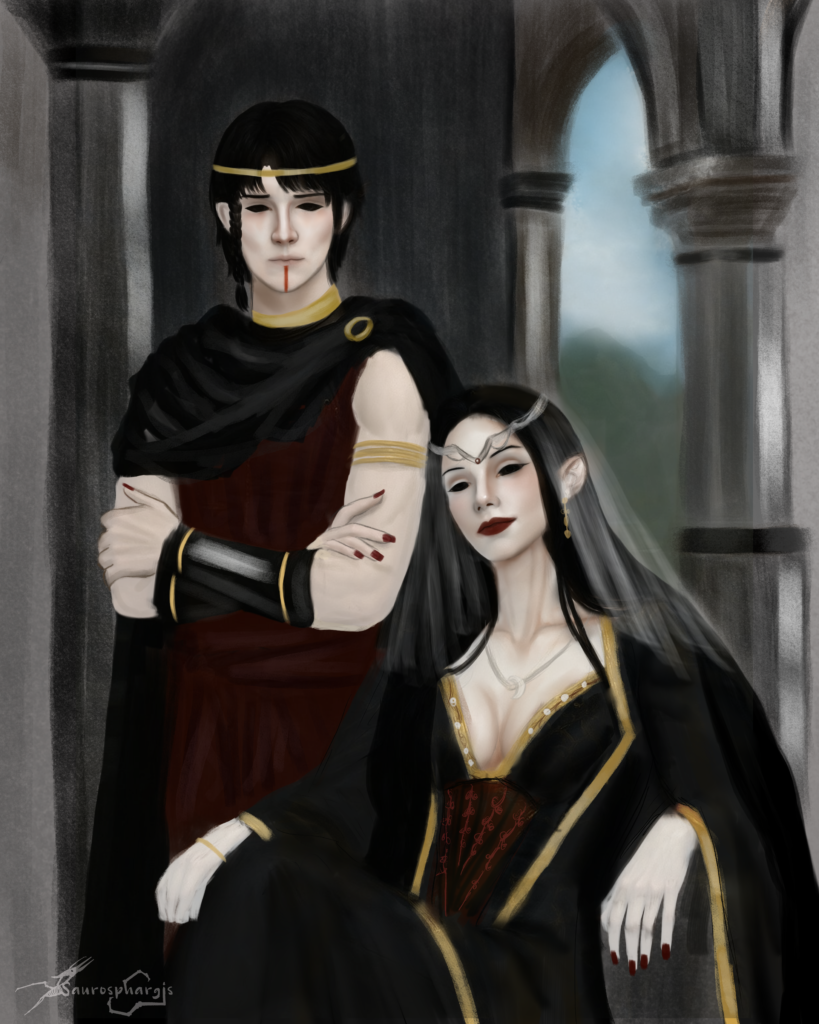
In 6 AE, Helmeras formed the Order of Helmeras, a diplomatic order to bridge the ever-existing differences between six kingdoms in the Empire. She took the isles on the west of Aschatava and build the Order’s headquarters there with the help of Derin, who was supposedly the new King of the valley, but relinquished the crown to their son, Eranarros Alzari, to be with Helmeras. Eranarros Alzari took the name Eran I Arderinei and named the valley Phyrozes.
Current Timeline
The Varkrys have long stood, and continue to stand, as the compass by which the other races of the Empire orient themselves. From the drafting of laws to the shaping of rule, their will guides both Thospeiros and the greater Empire alike.
In the present age, Ederav rests at 270 AE, under the reign of Emperor Vierros Alzari, whose rule is marked not by conquest, but by balance, decree, and his vision – Equilibrium Utopia.