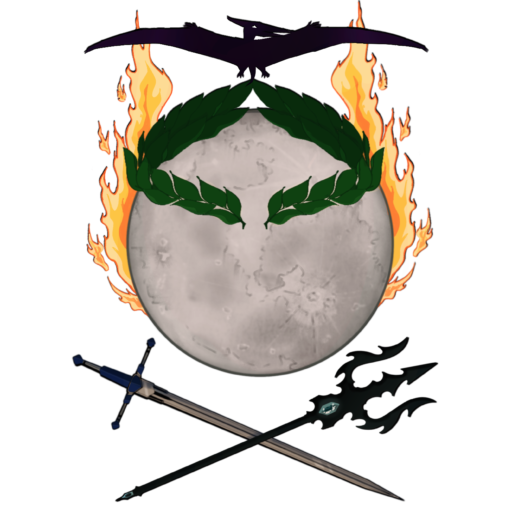
Vaherdal
The God of Moon
Vaherdal, also spelled Va’erdal or Vaherthal, is the son of The Chronicler and the brother of Elonie. He is the God of the moon and endless night, and is considered by many as the father of the Gods of Ath-Einhaf.
Vaherdal is frequently portrayed as a male figure with alabaster skin. His long black hair conceals his left eye as he sacrificed his eye to create the moon. Depictions in art and divination rituals vary: sometimes he appears as a shadowy man crowned with phases of the moon, other times as a tall, faceless, slender figure.
Historicity
According to the Holy Scripture of Ath-Einhaf, Vaherdal and his sister, Elonie, are the children of The Chronicler, a primordial being who created ‘time and space’ and tasked the two with developing and tending the domain. Together, they created the grounds and eventually Ehanfi, the living tree god, from their mingled blood. Though at that time, Ehanfi was just a dormant seed.
With Ehanfi remaining dormant, Elonie devoted herself to nurturing the slumbering seed, while Vaherdal, ever restless, turned his creativity to the earth itself. He gathered two chunks of rock and sculpted two mortals—Orros and Arras—in his own likeness. Unlike their creator, however, their eyes were deep voids, reflecting the endless night.
Yet unlike the gods, Orros and Arras were mortal. Though they gave rise to descendants, their lives inevitably faded, and Vaherdal, grieving their loss, cradled their souls within his left hand and carried them with him at all times.
Meanwhile, Elonie found that the Ehanfi seed was cold. She cut and spooled her golden hair to become the sun to rouse Ehanfi from slumber, but the children of Orros and Arras were scorched by its light. To shield his creations, Vaherdal split the earth and carved out dark refuges for them beneath the surface.
The siblings quarreled, for while Vaherdal lamented the suffering of his creation, Elonie pointed out that the sun’s warmth had finally coaxed Ehanfi to sprout. With a heavy heart, Vaherdal conceded, but insisted his mortal children needed to forage for food upon the land, where only moss and lichen grew in those early days.
Still, Elonie refused to withdraw the sun, leaving the children of Orros and Arras trapped in their shelters, hungry and crying for food. Their cries moved Elonie, who entreated her brother to craft a clear cycle for day and night. In answer, Vaherdal plucked out his left eye and cast it into the skies, creating the moon to mark the passage of time. By its gentle light, his people could finally emerge to gather food. Horrified by Vaherdal sacrificing his own eye, Elonie vowed to grant any wish he desired—a promise Vaherdal quietly kept.
Yet amid this new cycle of sun and moon, of day and night, another god emerged. When the world changed and the first transition between night and day took shape, Mayathi came into being. She embodied change and the mystery of beginnings and endings.
Mayathi sought Vaherdal and, moved by his grief, offered her own gift: to cradle the souls of the departed within her care, holding those souls until they have a chance to descend once more. From that time forward, she became the goddess of change and death.
It is at this point in the legend that the accounts begin to diverge. The Venefian tradition holds that Elonie remains Vaherdal’s consort, their rivalry and partnership shaping both the sun and moon. In contrast, the Varkrys believe that Vaherdal used the wish granted by Elonie to take Mayathi as his consort. The holy scriptures, ever ambiguous, refer to both Elonie and Mayathi as his consorts, while also stating that Helvarr became Elonie’s consort.