Empire of Ederav
Thalasanathur va Ederav
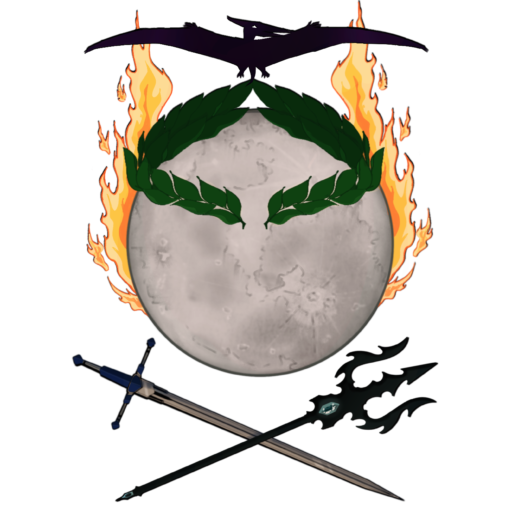
The Empire of Ederav, referred to in Eihanfi as Thalasanathur va Ederav, constitutes a union in which the six kingdoms of Ederav exist under a single, binding authority. For many generations prior to its establishment, the six sentient races inhabited separate territories, developing independently. Each race progressed at its own rate, establishing kingdoms, creating trade networks, and engaging in warfare according to distinct customs and ambitions.
Although contact among the races was frequent, coexistence remained inconsistent and unity was consistently rejected.
This period of separation concluded with the arrival of the Naha’thiir, colossal fire-breathing beings surpassing even the mighty rugha in scale. Their descent marked a pivotal turning point in Ederav’s history.
During the initial years of their dominion, the Naha’thiir appeared to govern with fairness and restraint. Over time, however, their rule became characterized by excess and cruelty. The Naha’thiir consumed livestock at unsustainable rates, hunted Ederav’s great beasts for sport, and incinerated dissenting leaders with their fire breath when grievances were raised.
The initial imposition of order by the Naha’thiir rapidly escalated into widespread devastation, ultimately creating circumstances in which survival required unity among the six races.
In response, the six races united to overthrow the Naha’thiir. Following this victory, representatives from each race convened and crowned Auxarros Alzari of Thospeiros as the first emperor, with Ehanfi serving as a living witness. Auxarros was selected not for lineage or conquest, but for his role in uniting the divided peoples and forging a collective will, an act regarded as both sacred and political.
The name Ederav itself is a relic of that moment of unity. It is formed from the initials of the six leaders who stood at the Empire’s birth: Clan Mother Eriona of Kraken’s Hold, Derin the Liberator, King Efikei Esharei, General Rokvir Varra, King Auxarros Alzari, and High Priest Veldhyr Teak. Together, their names became the Empire’s name. This is a constant mnemonic that Ederav was not founded by one race alone, but by all. It is bound by necessity, sacrifice, and law.
Ederav formally recognizes two chronological eras: the years preceding the empire’s formation are designated as BE (Before Empire), while the years following its establishment are labeled AE (After Empire). Although various calendar systems existed prior to unification, the Year of the Empire is now the most widely adopted.
Structure
Aschatava serves as the imperial seat of the Empire of Ederav, a territory established by divine decree from the remains of the fallen Naha’thiir. Following the unification of the six races, the Gods ordered that the carcasses of Naha’thiir be cast into the ocean, resulting in the formation of Aschatava—an immortal land where resources are never truly exhausted. Fields are replenished, mines are renewed, and the land is perpetually sustained as a divine blessing upon the unity of the kingdoms. Aschatava is not claimed by any single kingdom; instead, it exists as imperial ground, held in trust for all.
At the center of Aschatava stands the Trident, the region’s capital and the political core of the Empire. The Trident is situated at the confluence of three major rivers, above which rises God’s Chosen, the Imperial Palace. Once a mountain, its right half was transformed into a palace complex, featuring halls, courts, and sanctuaries. From this vantage point, the Emperor governs both symbolically and physically above the realms, positioned at the convergence of Ederav’s principal waterways. Aschatava functions as the Empire’s capital, with the Trident serving as its capital city.
Currently, the Empire of Ederav is governed by Emperor Vierros Alzari.
North-east of the Trident lies the Tombs of the Kings, a sacred necropolis reserved for royalty of any kingdom within Ederav who choose to be interred there. Kings, queens, emperors, and consorts rest side by side beneath imperial stone, their tombs not solely marked by kingdom or race, but also recorded by name and deed. Burial within the Tombs is both an honor and a declaration: that one’s loyalty in death belongs to Ederav as a whole.
To the east is Trader’s Grove, the largest and most populous city in Aschatava. Serving as the Empire’s commercial and cultural center, the city is renowned for its opulence and grandeur. Trade houses, guild halls, jewel markets, and pleasure districts thrive under stringent imperial regulation. Wealth is both evident and controlled, celebrated yet limited, reflecting Ederav’s principle that prosperity is permissible provided it does not disrupt societal balance.
Off the western coast are the Isles of Helmeras, a group of three islands that serve as the stronghold of the Order of Helmeras. Among these islands stands Guardian’s Fortress, the residence of the Pactbearer, while the Helmeras Headquarters operates as a center for governance, education, and archival preservation. The Isles provide training for new members, safeguard imperial scrolls, and prepare disputes for lawful adjudication. Although separated by a strait, the Isles maintain political centrality, observing, documenting, and intervening when the Empire requires administrative action rather than royal or military authority.
The Six Kingdoms of Ederav
Nahvosathur Kalasan va Ederav
Kingdom of Thospeiros
Kalasanathur va Thospeiros
Thospeiros, the subterranean kingdom of the Varkrys, lies beneath Ederav’s northern rocks as a vast underground realm whose depth rivals the surface kingdoms in sheer scale. Accessed through monumental cavern mouths, the kingdom unfolds into layered marble halls, bioluminescent fungal forests, subterranean seas, and cities carved vertically into cavern walls and ceilings. At its heart stands Crimson Sanctuary, the capital, a scarlet-lit imperial city built around ancient stone strata and sacred law chambers.
The kingdom is ruled by King Jaerros Alzari, whose authority is exercised through ancient Varkrys legal tradition rather than spectacle or conquest. Governance in Thospeiros is rigidly bureaucratic and deeply codified; law is treated as inherited truth rather than mutable policy. Though outwardly reserved, Thospeiros exerts immense influence over imperial administration, having shaped much of Ederav’s legal philosophy.
Life in Thospeiros is defined by restraint, sustainability, and permanence. Waste is considered a moral failure, recycling a civic obligation, and craftsmanship a form of devotion. Economically, Thospeiros serves as the Empire’s industrial and medicinal backbone, exporting refined ores, gemstones, recycled metals, spidersilk, moss linen, cave tetras, and a wide range of subterranean medicinal herbs and potions, while importing agricultural produce, pigments, surface luxuries, and crafted goods.
Kingdom of Phyrozes
Kalasanathur va Phyrozes
Phyrozes, the valley kingdom of the Traxei, occupies the fertile central lowlands of Ederav, shaped by rivers, open plains, and gentle highlands. Its climate follows a distinctive tri-seasonal cycle—sun, rain, and snow each claiming roughly a third of the year—allowing continuous agriculture and steady movement across the land. Rising at its center is Rughavar, the capital, a colossal colosseum-like city built in concentric rings that function simultaneously as fortress, civic hub, and cultural arena.
The kingdom is ruled by King Sohan II Ardeyi, whose reign balances royal authority with practical governance. Historically a mercantile and transport power, Phyrozes now operates as the logistical engine of the Empire. While all large-scale transportation services are formally held under imperial authority, Phyrozesathur institutions act as the operational bodies, functioning much like a contracted arm of the Empire and remaining under constant audit by the Order of Helmeras.
Traxei culture emphasizes adaptability, spectacle, and communal life. Rugha riding is both cultural identity and practical necessity, while public gatherings, competitions, and displays of skill dominate civic life. Phyrozes exports agricultural surplus, dyes, trained rugha, and logistical expertise, while importing refined metals, stone, luxury goods, and industrial materials required to sustain imperial transport networks.
Theocracy of Venefigus
Atheinrox va Venefigus
Venefigus, the verdant theocracy of the Venefian, is a dense tropical realm of layered canopies, humid air, and meticulously cultivated sacred groves. At its core lies Ehan-Rhala, the capital, built around the colossal living form of Ehanfi, whose presence defines both the spiritual and physical geography of the land. No forest here is wild; every growth is observed, guided, and recorded.
The realm is governed by High Priest Aegyr Birch, who serves not only as Venefigus’ supreme authority but also as the religious figurehead of the entire Empire. Religious doctrine and law are inseparable in Venefigus, yet they are codified and methodical rather than zealous. The theocracy emphasizes stewardship, continuity, and balance, maintaining cooperation with imperial authority so long as Ehanfi’s sanctity remains inviolate.
Venefian society is slow-paced and communal, viewing growth, decay, and renewal as sacred cycles. As tree-kin, the Venefian cultivate wood through controlled growth techniques, shaping living trees specifically for future harvest without killing them. Venefigus is the sole legal source of timber within the Empire and exports cultivated wood, medicinal herbs, alchemical ingredients, and potions, while importing metals, stone, crafted goods, and non-jungle foodstuffs.
Thalassocracy of Chrenatia
Rem’aseirox va Chrenatia
Chrenatia, the oceanic thalassocracy of the Aqsha, encompasses all waters between Ederav’s mainland and the fortified island ring known as the Stronghold. It is not defined by land borders but by currents, depth, and migratory routes. The surface-accessible Great Crescent Isles serve as the capital, allowing interaction with land-dwelling races.
Chrenatia is ruled by Clan Mother Lembayung of the Jade Seas, whose authority flows through kinship networks and sea law rather than fixed territory. Governance is conducted through maritime councils, and imperial authority is recognized primarily in matters of regulated trade and navigation, while cultural autonomy beneath the waves remains absolute.
Aqsha society is communal and territorial, with identity shaped by scent, pod, and ocean region rather than bloodline. Land-dwellers are viewed as temporary guests within an eternal domain. Chrenatia exports naval protection, maritime intelligence, pearls, coral, and deep-sea resources, and imports metals, surface-crafted tools, and preserved foods unsuitable for aquatic environments.
Ulfdinhar Dominion
Ulfdinharasathur Ah’rairox
Ulfdinhar, the mountainous dominion of the Ulfhar, spans the southern highlands of Ederav in a landscape of snowbound peaks, frozen forests, and tundra valleys. Despite its harsh climate, wildlife thrives due to geothermal veins beneath the stone, established migratory routes, and carefully maintained predator-prey balance. Warm stone beneath the earth prevents ecological collapse even during prolonged winters. The capital, the Great Erra Mountain, is both fortress and seat of power.
The dominion is ruled by General Kael Vakveldir, known as the Wolf of Ulfdinhar. Authority is earned through merit, survival, and martial capability rather than lineage. Governance is militarized, direct, and pragmatic, with loyalty to the Empire grounded in mutual defense rather than ideology.
Ulfhar culture values endurance, honor, and self-sufficiency. Community bonds are forged through shared hardship, and leadership is respected only so long as it remains strong. Ulfdinhar exports furs, pelts, preserved meats, and elite warriors, while importing agricultural goods, refined tools, and medicinal supplies.
Kingdom of Zi’fen
Kalasanathur va Zi’fen
Zi’fen, the volcanic kingdom of the Sethri, is a land of active calderas, ash plains, and obsidian ridges shaped by constant geothermal upheaval. Rivers of magma carve the terrain, and volcanic heat is integrated into settlement and industry rather than avoided. At its core stands Caldera’s Hall, the capital, built into the rim of a great volcanic basin.
The kingdom is ruled by Queen Ferynith Nixei, whose authority is reinforced by forge councils composed of master smiths, engineers, and fire-priests. Political power in Zi’fen is inseparable from creation and control; innovation is encouraged but strictly regulated to prevent imbalance.
Sethri culture reveres fire as both sacred force and disciplined tool. Their fire-winged forms are symbols of power and restraint rather than freedom. Zi’fen exports master-forged weapons, tools, lava glass, volcanic stone, and heat-resistant materials, while importing food, timber, textiles, and administrative labor required to sustain its industrial focus.
Order of Helmeras: The Weaving Web of the Empire
The Order of Helmeras was formed in 2 AE by Princess Helmeras Alzari, the sister of Emperor Auxarros Alzari. It stands as the principal unifying institution of the Empire, entrusted with preserving cohesion among its six constituent kingdoms despite their profound cultural, political, and societal differences. Where the Empire is divided by geography, lineage, custom, and belief, the Order of Helmeras exists to serve as the connective structure that binds its disparate realms into a single imperial body.
Vested with authority by the Emperor, the Order of Helmeras may be formally directed to conduct audits, investigations, and comprehensive assessments within any kingdom under imperial jurisdiction. Such mandates may include the examination of governance, financial and resource stewardship, military readiness, legal adherence, and matters deemed vital to imperial stability. These interventions are not instruments of conquest, but mechanisms of oversight, intended to maintain balance rather than impose uniformity.
In equal measure, the kingdoms themselves possess the right to petition the Order. Through such petitions, the Order may be requested to undertake diplomatic missions, mediate disputes between realms, arbitrate contested claims, or conduct formal evaluations including the reconfirmation of borders, treaties, and historical accords. In this capacity, the Order acts not as a ruler, but as a neutral executor of imperial law and precedent.
Deliberately structured to operate beyond regional loyalties and cultural affiliations, the Order is composed of individuals sworn to impartiality above kinship, crown, or creed. Its authority derives not from force of arms, but from its recognition as an institution standing apart from the ambitions of any single kingdom. Through continuity, record-keeping, and institutional memory, the Order provides stability where rulers change and alliances shift.
Thus, the Order functions as both bridge and ballast: a mediator between vastly different peoples, and a stabilizing weight preventing the Empire from fracturing under the strain of its own diversity. Without it, the six kingdoms would remain merely allied realms. Through it, they endure as an Empire.
The Structure
The Order of Helmeras is governed by the Pactbearer, who holds absolute authority over the Order. While the Pactbearer does not handle directly delegate tasks to their inferior, they have the right to conduct surprise assessments and to entirely stop and remove any Order’s officials and disband missions. The Pactbearer also has the right to question and potentially refuse any laws drafted and passed by the kingdom leaders and even the Emperor, though negotations would always take place and the Pactbearer cannot singlehandedly disband a law.
The Pactbearer does not have the right to overturn any cultural practice and norm practiced in each kingdom, regardless of their personal views and even if they are
Halcord, Valacar, Orrenter
Scrollkeepers
Scrollhand
Verdant