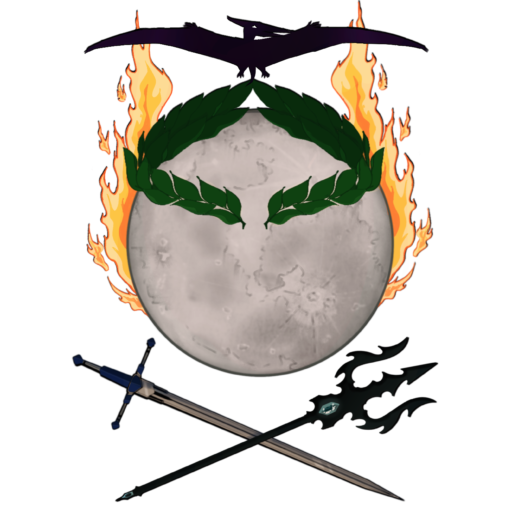
Nagor I
Book I • Chapter I
“We shaped from our will a land for you, and we withdrew not in absence but in watchfulness, to guard what we love into becoming.”
-Orunathur, verse 21, Holy Scripture of Ath-Einhaf.
The Trident’s silence was the very first thing Nagor noticed.
This was not tranquil nor serene. It was eerie and cold in the way a city would fold under its ruler’s scrutinizing stare. Even the wind slid through marble courtyards, subdued, as if it feared to whisper.
Nagor Ardeyi had imagined warmth, or at least a ceremony. As the new halcord — a diplomat who bridges the empire and the six kingdoms within it — he thought Emperor Vierros Alzari, who was famed for his gentleness, would greet him with open arms. He pictured garlands, rehearsed speeches, or perhaps a buxom servant waiting with rainbow lichen tisane, a practiced smile, and an even more practiced mouth.
Instead, he and Lady Dune found themselves perched on a balcony of God’s Chosen, gazing — or perhaps being scrutinized — by the statue that loomed above. Hecarros Alzari was roused to existence once more – in marble, sitting tall atop a mound of skulls. One foot was planted firmly on tangled skeletons beneath him, his hands resting on his blade.
It took Nagor a moment to process the view: the statue’s stone gaze swept the city below, cold and watchful, akin to a storm ready to swallow a whole coast and those who dwell in it. Even as a mere sculpture, Hecarros radiated a warning to anyone who might mistake Alzari’s restraint for weakness.
The crowd in the plaza parted in silent dread as guards dragged the condemned officials forward. Robbed of silk and jewels, they arrived bound in rags and leather. The once-proud nobles now paraded as sacrifices for Hecarros — a grim, indelible spectacle. Or fools, Nagor thought. Nothing would ever escape the eyes of Vaherdal’s son. Not even those haughty criminals who raised their chins and stood as if they feet still belonged atop the soil of this empire.
Nagor stroked Dune’s warm golden scales. his fingers tracing comforting patterns that made the beast croon as he listened to the prisoners’ crimes, each accusation delivered with cold precision. His touch was steady, but inside, unease roiled his mind. He wondered if this was what awaited anyone who strayed — if loyalty could ever be enough in a city built on judgment this absolute. Nagor found Dune’s steady warmth grounding and clung to it, silently promising himself he would never give the emperor cause to tempt his own fate.
Corruption.
Extortion.
Systemic harm—sabotaging facilities, conducting harmful experiments on vulnerable children and women.
Theft… from Utopia’s coffers, no less.
They shattered the Equilibrium Utopia Vierros Alzari built with bleeding hands and sleepless nights — a feeble balance of justice, prosperity, and peace envied by every court. To the lawmaker, such crimes demanded eternal exile. Out of Ederav to the cradle of Mayathi.
Nagor’s periwinkle gaze followed the executioner — a towering Venefian who had been sharpening his blade. His voice was soft when he told the poor fools that the condemned may rely on their last words to the crowd spectating their fate.
Six of them were silent; still as a river frozen by winter. One spoke, however; A tall Ulfhar woman with cold blue eyes, her hair matted and haggard — though Nagor was certain it was once soft and lustrous, glimmering like the sun — opened her mouth and spoke, her voice stern and her stare rigid.
“Your emperor is a delusional fool,” she sneered. “Mercy? Kindness? Wasted on the likes of you! You exist for one purpose — being fodder to those in power!”
The Ulfhar noblewoman’s words were immediately met with outrage. Commoners clamoring by the gallows shouted in fury, fists jutting into the air as jeers erupted. Because whatever else would meet such vicious words, if not wrath and wroth?
Though before it could escalate any further, the executioner decided that it was enough and raised his blade.
The sharp, wet cracks of the first swing slammed through Nagor’s ear, even at this distance. He flinched as the world narrowed to the brutal sound and heads tumbled into the stone trough at Hecarros’ feet. Blood traced crimson paths down the marble, pooling at the statue’s left foot.
Nagor’s heartbeat thundered, his muscles turned rigid. The crowd cheered and bowed their heads, gleefully accepting their emperor’s judgment — a ruler who refused to let rot spread. Vierros the gentle was as timid as a river: calm and steady until a boulder breaks its flow.
Then he became floodwater; swift, merciless, inevitable.
Nagor decided he had seen enough. He reached for his kahfi, slipping it from his neck and lifting it to play a brief, sharp melody only Lady Dune could understand. Responding instantly, she arched her neck and roared before she snapped her wings wide. With a single leap, she vaulted to the balustrade, pushed off, and climbed hard for the sky, scattering clouds as she rose. Up and up they soared along the carved half of God’s Chosen until they reached a grand window.
Only then did Nagor cease playing — the signal for Dune to land.
Dune entered through the grand window, landed on her talons, and tucked her wings. A half-asleep Sethri herald flapped his fire wings and immediately announced, “Halcord Nagor Ardeyi, his Imperial Majesty awaits!”
Nagor unlatched himself from Dune’s saddle and hopped off. “Where, pray tell, is the Emperor?”
“In his solar, sire,” the Sethri herald answered with another flap of his fiery wings. “I shall guide your mount to the rugha stables.”
Nagor frowned at that. He had always loathed parting from his beloved Lady Dune, though he knew she could hardly trail him through the castle like a lost ruthigi. “Tell the stable master that my lady prefers twigs and leaves,” he added anxiously, patting Dune’s beak with his bronze-colored hand. “Especially dried leaves — the ones that have lingered atop the soil for ages.” He pressed a leaf into her palm-sized nostril, and Dune trilled in pleasure, inhaling its brittle, earthy scent.
“I will notify the stable master right away,” the Sethri herald replied.
“And ensure that her stables shall be comfortable. She is young, but she is a great rugha. She needs space, you see—”
“Halcord,” the Sethri herald abruptly cut him off. “The Emperor awaits.”
“Ath-Einhaf curse me,” Nagor muttered, smacking his head. “Of course. Thank you. I will— he will see me. I mean, His Imperial Majesty—”
“Is waiting,” the herald huffed. “The Varkrys have an absurd level of patience, halcord, but one ought—”
“I’m going, by the gods,” Nagor groaned. Then, catching himself, he attempted a stiff little bow mid-stride, his voice tightening with formality. “Thank you.”
Nagor Ardeyi hurried off toward the eastern hallways.
“Halcord!” The Sethri herald called after him again, testing the last threads of Nagor’s patience. The man had urged him to hurry, yet now further delayed him…
Nagor spun around, attempting a glare — though he doubted the fire-winged herald would be cowed — and snapped, “What now!?”
See? He did not. Instead, he smirked. As if he was looking at a fluffy, defenseless na’ita. “The imperial solar is that way.” He pointed at the hallways, the opposite of where Nagor was going.
Nagor muttered a curse, offered a silent thanks to the Sethri, and spun around, nearly toppling a vase with his cape. With a clumsy movement, he propped the vase back in its place and strode through the marble halls, taking in his surroundings.
This place was half palace, half mountain. He wondered if the Alzari would ever carve the entire mountain into a single palace, but ultimately, Nagor doubted it. The Alzari revered the Gods too much to destroy their handiwork without cause. At the same time, they were prideful and boastful — justified, they were ancient and oh-so-mesmerizingly beautiful — that they carved the right half of a mountain into a palace and sat on it as if it were a gift from the gods themselves.
When Nagor arrived, two silent Ulfhar guards swung open the doors with their clawed hands. As Nagor stepped inside, a breath of cool, lichen-heavy air clung to his skin; it smelled faintly of cold, wet stone and rich incense, and each of his footsteps echoed softly in the hush. The solar was dim, lit only by the faint silver glow of moon lichen breathing along the walls. Heavy crimson silk sealed the curtains, and before an ornate tapestry of Hecarros’ last battle with Aylair the Warmonger stood Emperor Vierros Alzari.
His Imperial Majesty’s hair spilled to the marbled floor like a river of ink. His cloak, black and crimson, shrouded him, red threads glinting like rubies in the nighttime. His skin gleamed white as polished marble, and his eyes — those eyes — were perfect abysses; calm, bottomless, still, yet brimming with storms and wisdom of no end.
The eyes of Vaherdal.
Nagor swallowed and bowed his head deeply — deep enough to avoid meeting the eyes of Vaherdal, the eyes of the eldest God. The emperor barely acknowledged him, simply watching the marbled plaza below as the final head rolled. Soon, the heads were gathered, the pale marble scrubbed clean, and the statue of Hecarros seemed satisfied enough with the grotesque offering.
Only then did the emperor speak.
“Welcome,” Vierros turned his head with intentional slowness, the kind all Varkrys seemed to possess. “Halcord Nagor Ardeyi.” His speech was low and gentle, softer than a breath. He spoke so quietly, as if any louder would risk wounding his own fragile throat.
Nagor bowed, his throat parched and cold as he greeted the emperor. “Your Imperial Majesty.”
There was a pause before Vierros’ pale lips curved in a smile that was almost — almost — pleasant. But not quite. The Alzari are closer to Vaherdal than to any mortal, Nagor’s father used to say. Now those words echoed in his mind, looping like a drunken bard’s endless fanfare.
“My utmost apologies,” Emperor Vierros moved forward, silent and watchful. “For the untidy sight.”
Nagor’s stomach knotted as Vierros the Gentle spoke. The emperor dismissed the execution as merely untidy, as if it was nothing. “If I may inquire, sire…” Nagor managed, eyes locked on pale marble. “Of those whose heads fell?”
Those bottomless eyes locked onto Nagor — fathomless, stripping away every lie before it could form. Nagor felt like a fragile trinket in the palm of a God who, for now, chose not to crush him between his palm.
“They were against my laws,” Vierros stated with a smile. “That much, I could tolerate.”
And to that, Nagor smiled – his lips curled up higher on the right awkwardly as a chill crept down his spine. He found no solace in that easy tolerance. His father’s stories of justice surfaced — how mercy wielded a double-edged blade, and true power lay in sparing the vulnerable. Vierros’ calm logic seemed thin as ice: surface order, threat submerged. Nagor wondered — would his own sense of justice last if laws ruled everything and forgave nothing? If accused, would intent ever matter, or only obedience?
He watched as the emperor glided closer, his cloak of spidersilk and moss linen whispering behind him. He stopped just short — close enough to tower over Nagor.
“However, I discovered,” Vierros continued, voice soft but chilling on Nagor’s skin. “That funds for homes for the poor were stolen by them.”
Emperor Vierros Alzari tilted his head, letting his long black hair spill past his shoulder and onto the floor. He studied Nagor with a terrifying tenderness — the kind reserved for those who hold the world in their hands and decide where mercy should fall. Or if it should ever fall to begin with.
“What is the use of Ederav and its vast land, halcord?” Vierros mused, “If people cannot afford to live in it?”
“None,” Nagor replied quickly, eyes moving away from that pair of endless abysses. “None, Your Imperial Majesty.”
Vierros smiled. He lifted an alabaster hand and rested it gently on Nagor’s head, smoothing his untidy locs with crimson nails before withdrawing. “Good,” he assented. “You will learn my ways in time. And my ways are the only correct ways.”
Nagor was about to offer a clever remark or an awkward joke — anything to cease his nerves when facing the Emperor himself — when a knock shattered the quiet tension. He straightened as Vierros’ void-like gaze shifted to the door. The Ulfhar guards opened it, admitting a court official who bowed so deeply his dark hair nearly swept the floor.
“Your Imperial Majesty,” he greeted. “Forgive the intrusion. It concerns… the remains. Their families, none have come to claim them.”
Nagor’s sky-blue eyes widened at that. Even the condemned, he’d heard, were usually claimed by their kin. The official continued, hands folded politely before him.
“Perhaps out of shame, my emperor. Deeply so. Most refuse to acknowledge the condemned as relatives at all,” the court official continued. “And… Ah, Lord Lunerros Alzefeni’s lady wife ran away with a Venefian priest.”
Nagor blinked, and Vierros smiled — a small, nearly invisible curve of his lips, like the first crescent of the moon. Beautiful, Nagor thought. And utterly chilling.
“I see,” Vierros nodded. “Lunerros.”
“Yes,” the court official nodded. “Lord Lunerros Alzefeni-”
“He is no lord,” Vierros interjected as he advanced closer to the court official. “Nor he is an Alzefeni. I shall not let the name of our kingdom’s great house be stained by a wretched rot named Lunerros.”
The court official quickly inclined his head, and more of his long, dark brown hair fell off the elaborate binding a Varkrys like him would don on. “Yes, sire. Pardon me.”
“Very well,” Vierros nodded back. “If the families do not wish to attend to their remains, then send the bodies to Venefigus. The gardenwardens would make do with it.”
“The-” The Varkrys stopped his words before he spoke again. “The gardenwardens. We shall… ah, compost their bodies?”
“Death should nourish life,” the emperor replied. “They have stolen from the living, and we will let them give something back in the end. Such is a mercy I am… willing to grant.”
Nagor gulped, caught off guard by his own wavering. Was it monstrous or merciful, this logic? Part of him recoiled, yet another part grudgingly admired the grim symmetry.
The court official bowed again, nearly tripping over his long robes in his rush to obey. Nagor, meanwhile, stood still, breath frozen as he watched the gaunt Varkrys’s abrupt exit. Vierros, serene and alabaster-pale, fixed him once more with those void-like eyes.
“Balance, Halcord Nagor,” Vierros murmured, soft and light yet suffused with command. “Ederav must breathe evenly, or it rots.”
Nagor could only nod, words lost to him. All he had was the slow, dawning certainty that this Varkrys he served — the Emperor of this vast empire, this quiet, almost wraithlike figure — was not simply ruling.
Vierros Alzari was pruning it.
With tenderness. With precision. With resolute, terrifying love.
Nagor swallowed hard. He took a cautious step back and promptly caught his boot on the curved leg of a vase stand. The vase — an elegant, moonstone-glazed heirloom engraved with prayers to Vaherdal, older than the entire Ardeyi line — tilted. Wobbled. Chose to fall.
Nagor’s soul nearly fled his body. His bronze skin paled as he sprang, arms flailing. “No, nonononono—”
But before he could reach the vase, a soft sweep of cloak brushed past him. The emperor moved — swiftly, but without haste. It was as if darkness itself shifted to intervene. One moment, the vase was falling; the next, it rested in his pale hand, steady and unharmed.
Nagor froze mid-lunge, fingers grasping only empty air.
Vierros regarded him. He towered over Nagor, still like a cloudless night, before a faint, nearly imperceptible upward twitch crossed his lips.
“I—” Nagor gulped, arms flailing as he floundered. “Your Imperial Majesty— I’m so— I didn’t— the floor moved! No, that’s ridiculous…” He muttered to himself, blue eyes wide as he met Vierros’ endless gaze, a chill crawling over his skin. “Someone cursed me. I know it.”
Vierros only tilted his head ever so slightly, long black hair falling past his back to the floor.
“You are spirited,” he murmured, voice soft as velvet.
Nagor blinked rapidly. “Is that— Is that good…?”
“It is…” Vierros regarded him like an Altehuri scholar examining a curious new species. “…Entertaining.”
Entertaining.
The Emperor of Ederav called him ‘entertaining’.
Nagor had no idea if that was a compliment or a death sentence. Vierros simply adjusted the vase, nudging it a little to the left until it sat perfectly centered on its stand.
Then he looked at Nagor again, and there it was — a glint in those void eyes. Not amusement as common folk know it — Vierros neither laughed nor chuckled—but a rare softness uncommon amongst the Alzari.
“Halcord,” the emperor cooed, “if you intend to break anything, do warn me first.”
Nagor straightened, eyes wide with mortification, before he looked away. His fingers fidgeted with the rings on his right hand. “Y-yes, Your Imperial Majesty.”
Vierros nodded, his cloak settling about him as a breathing shadow. “In time, halcord,” he said. “I suspect I will learn to anticipate… your movements.”
And Nagor could only pray to Ath-Einhaf that the emperor meant that gently.